
What Does Public Liability Insurance Cost for Locksmiths?
Last Updated: November 4, 2026
Quick Summary
The cost of locksmith insurance for public liability depends on your cover level, turnover, claims history, work type, staff and excess, so the only reliable figure comes from a broker who has seen your trade and claims record. Public liability cover is not generally a legal requirement for locksmiths, though many clients expect it.
A £1 million cover limit costs less than a £5 million limit.
Higher turnover means a higher premium because the exposure grows.
One paid claim can push your renewal up sharply.
Emergency entry and lock changes carry more risk than key cutting alone.
Employers' liability insurance is a legal duty for businesses that employ staff.
Table of Contents
Why Public Liability Cover Is a Locksmith's Most Important Policy
What Drives the Cost of Public Liability Insurance for Locksmiths
Locksmith Business Insurance Requirements: What You Legally Need
Professional Indemnity Insurance for Locksmiths: Who Needs It and Why
How to Verify Locksmith Accreditation and Insurance Before You Book
Why Public Liability Cover Is a Locksmith's Most Important Policy
If you run a locksmith business, or you are hiring one, the cost of locksmith insurance for public liability is the figure that matters most.
Public liability insurance is a policy that pays towards legal costs and compensation if your work injures someone or damages their property.
The stakes are higher than they look. A mobile locksmith works on other people's vehicles at the roadside, often in poor light and bad weather.
What Public Liability Insurance Actually Covers
Cover typically extends to third-party injury and third-party property damage arising from your work.
Most policies exclude damage to the vehicle you are working on if you are holding it in your care, custody or control.
If you want the detail on what a policy will and will not pay for, our guide to auto locksmith insurance coverage explained sets out the common inclusions and exclusions clause by clause.
For a customer, the practical point is simple: ask to see a current certificate and check the policy is live, not just that the locksmith says they are insured.
What Drives the Cost of Public Liability Insurance for Locksmiths
Premiums move with risk, not with the size of the advert in the local paper. A sole trader working from a van pays less than a firm with staff, premises and a fleet. The useful question is which of your business choices is pushing the number up, and by how much.
The main levers are straightforward:
Cover level: a £1 million limit costs less than a £5 million limit. Cover limits vary with the work and the contract, so check the limit each client requires.
Turnover: higher turnover means a higher premium, because the exposure grows. Insurers usually rate on turnover bands rather than an exact figure, so a small increase near a band boundary can move the premium more than expected.
Claims history: one paid claim can push the renewal up sharply, and some insurers will decline to quote for two years after a large property damage claim.
Work type: emergency entry and lock changes carry more risk than key cutting alone. Vehicle entry, key programming and work on high-value marques attract higher rates than domestic lock replacement.
Staff and subcontractors: each additional pair of hands adds to the wage roll and the risk. If you use subcontractors, check whether they are covered under your policy or need their own.
Excess: a higher voluntary excess lowers the premium but means you fund small scratches and scuffed door cards yourself.
Cover Level, Turnover and Claims History
The only reliable figure comes from a broker who has seen your trade, your claims record and the limit your clients demand.
Each of these factors moves the premium, and claims history is usually the biggest single factor.
Pricing depends on your trade, your claims record and the limit your clients demand, so ask your broker for a written schedule rather than a headline number.
Watch out: buying on price alone often means a low limit or a wide exclusion for work on customer vehicles.
Locksmith Business Insurance Requirements: What You Legally Need
Public liability cover is not generally a legal requirement for a locksmith, though many clients expect it. Employers' liability insurance is a legal duty for businesses that employ staff (Employers' Liability (Compulsory Insurance) Act 1969).
That distinction trips people up. Many commercial clients, landlords and fleet contracts will ask to see public liability cover.
Our locksmith business insurance requirements break down like this:
Policy | Legally required? | Who needs it |
Employers' liability | Yes, if you employ staff | Any business with employees |
Public liability | No, but expected | All locksmiths dealing with the public |
Professional indemnity | No, but often requested | Locksmiths giving advice or programming keys |
Motor trade / commercial van | Yes, for road use | Any mobile locksmith |
The Health and Safety Executive guidance on employers' liability insurance confirms the legal position for businesses that employ staff. Check the current rules with the HSE before you trade.
Professional Indemnity Insurance for Locksmiths: Who Needs It and Why
Professional indemnity insurance is generally designed to cover claims that advice or workmanship was faulty, rather than physical damage.
Not every locksmith needs it. A sole trader doing basic entry work can often manage with public liability alone.
Where it earns its keep is on newer vehicles.
Some fleet and commercial clients may ask for it as a condition of the contract.
How to Verify Locksmith Accreditation and Insurance Before You Book
Ask for the certificate before you agree to the job, not after. Our guide to verifying an insured auto locksmith gives you practical steps to confirm the cover is genuine. A genuine locksmith will send a copy without hesitation.

Here is the checklist we would use:
Ask for the insurer's name and the policy number
Check the policy is current, not expired
Confirm the cover limit is stated in pounds
Ask whether work on customer vehicles is included
Check the locksmith's accreditation with the awarding body
Confirm the business name matches the certificate
If the paperwork does not match the person at your door, do not hand over the keys. Call the insurer's claims line and ask them to confirm the policy is live.
Checking RAC Accreditation and Insurance Documents
RAC accreditation indicates the locksmith has been assessed against the RAC's standards. It is a useful signal, but it is not the same as insurance.
Ask for both. Our guide to verifying locksmith accreditation walks through the documents step by step.
Watch out: a screenshot of a certificate proves nothing. Ask for the full document and check the dates and the business name against the invoice.
The Real Cost of Choosing an Uninsured Locksmith
The cheap quote is rarely cheap. An uninsured locksmith who damages your door frame, weather seals or paintwork leaves you to fund the repair yourself. What most guides never explain is what that repair actually costs, how to inspect for damage afterwards, and what legal route you have if a professional causes it.
What botched entry actually damages, and what it costs to put right
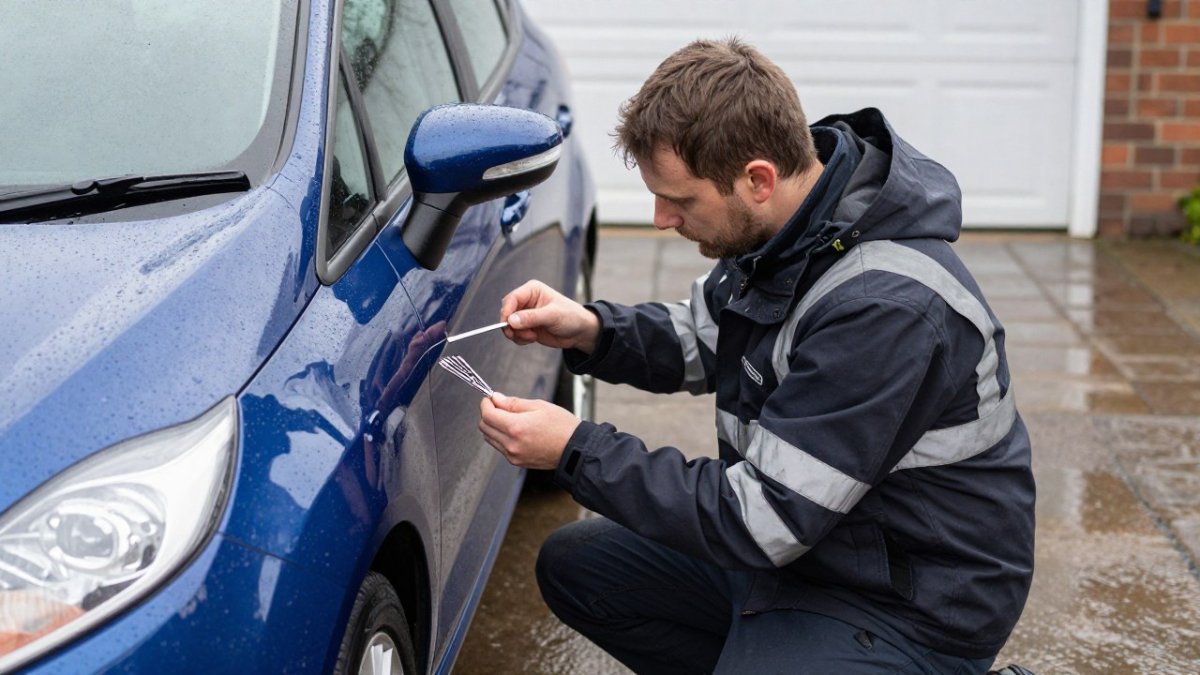
Improvised tools and excessive force can damage vehicle components. Repair bills vary widely depending on the damage involved.
Door frame and aperture: bending the frame or chipping the paint around the aperture can mean a bodyshop repair and respray of the door.
Window regulator and glass: forcing a window or levering against the glass can crack it or strip the regulator mechanism.
Weather seals and door card: torn rubber seals let water in, and a damaged door card means trim clips and sometimes a new panel. Small items individually, but they add up.
Central locking and wiring: poking behind the door card can damage the wiring harness or the central locking actuator, turning a lockout into an electrical repair.
Immobiliser and key programming: a failed programming attempt on a modern vehicle can leave it immobilised and needing a main dealer visit, which is where the largest bills appear.
Add the cost of any original call-out you have already paid, and an uninsured repair can end up costing more than an insured professional's work.
How to inspect your vehicle after any entry attempt
Before you pay and before the locksmith leaves, walk around the vehicle and check the following:
Look along the door aperture and frame for fresh scratches, chips or a gap where the door sits proud of the body.
Open and close each door and the boot; listen for a change in sound or a latch that no longer catches cleanly.
Check the window seals for tears or displacement, and run the window up and down to confirm the regulator moves smoothly.
Test the central locking from the key fob and from the interior switch.
Photograph any damage immediately, with the locksmith and their van in at least one frame, and note the time.
If a professional causes damage: the recovery route
If an insured locksmith damages your vehicle, there is generally a route to recovery through their insurer:
Record it in writing. Ask the locksmith to note the damage on the invoice or job sheet before they leave, and keep your own photographs and notes.
Get a repair quote from a bodyshop or dealer so you have a documented figure rather than an estimate.
Contact the locksmith's insurer directly. Ask for the insurer's name and claims line from the certificate, and report the damage as a third-party claim. You do not need to rely on the locksmith to do this for you.
Keep the paper trail, certificate, invoice, photographs, repair quote and correspondence, in case the claim is disputed.
Escalate if needed. If the trader is a member of a trade body or accreditation scheme, its complaints process can apply pressure. For unresolved disputes, the small claims route through the courts is available for modest sums.
With an uninsured trader, steps three and five largely disappear. You are left chasing an individual for money they may not have, and the repair falls to you or your own motor insurer.
There is a safety angle too. An uninsured operator has no insurer checking their methods, so improvised tools and excessive force become more likely.
Choosing an accredited, insured locksmith is not about paying more. Our article on the benefits of using local accredited locksmiths explains why that matters in practice.
Ask Us Now: Get a Fully Insured Locksmith to Your Vehicle
Salisbury Auto Keys is RAC-accredited and fully insured, and we have been running as a family business since 2018. We cover Wiltshire, Hampshire, Dorset and parts of Somerset, and we come to you at home, at work or at the roadside.
Every job carries our 12-month guarantee, and our customers have left more than 60 five-star reviews on Facebook and Yell. If you are locked out or need a replacement key, you can see our full range of services and get in touch.
Frequently Asked Questions
Is public liability insurance a legal requirement for locksmiths?
No, public liability insurance is generally not a legal requirement for locksmiths in the UK, though it is widely recommended. If you cause damage to a customer's vehicle or property while working, you could be held personally liable for the repair costs. Most reputable locksmiths carry at least £1 million in cover, and many accreditation schemes require it. Always ask to see a current certificate before allowing work to begin.
What does public liability insurance cover for an auto locksmith?
Public liability insurance covers third-party injury or property damage caused by your work. For an auto locksmith, that includes scratched paintwork, damaged door seals, broken window regulators or a harmed central locking system during a lockout. It does not cover your own tools or vehicle, and it does not cover faulty workmanship, which is where professional indemnity insurance comes in. Check both policies are in place before booking.
How much does professional indemnity insurance cost for locksmiths?
Professional indemnity premiums depend on your turnover, claims history and the level of cover you choose. A sole trader with a clean record will pay less than a multi-van operation. Rather than quoting a single figure, ask your broker for a combined policy that includes public liability, professional indemnity and commercial vehicle cover.
Do I need specific insurance for mobile auto locksmith services?
Yes. A mobile locksmith works at the roadside, in car parks and at customers' homes, so you need commercial vehicle cover that reflects business use, plus public liability that extends to off-site work. Tell your insurer exactly where and how you operate, and confirm the policy covers the work you carry out on customer vehicles.
Locked out, or worried about whether the locksmith you are about to call is properly covered? Ask us now, and we will confirm our insurance and accreditation before we set off, so you know exactly who is coming to your vehicle.
Comments