
How to Open a Locked Car Door Without a Key
Table of Contents
Before You Try Anything: Safety and Damage Risks
DIY Methods to Open a Locked Car Door Without a Key
Wedge and Long Reach Tool
Shoelace Method for Pull-Up Locks
Coat Hanger for Older Vehicles
Smartphone Apps and Remote Unlock
When to Stop and Call for Emergency Car Lockout Assistance
Finding a Mobile Locksmith Service Near Me
What Does Lost Car Key Replacement Cost?
Insurance and Roadside Assistance Coverage for Lockouts
Pre-Attempt Coverage Checklist
How a Failed DIY Attempt Affects a Claim
Conclusion
Frequently Asked Questions
Last Updated: September 20, 2026
Before You Try Anything: Safety and Damage Risks
Modern cars are harder to open than older ones. Side impact beams, deadlocks, and laminated glass have made traditional methods less effective.
Your door frame and weather stripping are fragile. Prying too hard can bend the frame or tear the seal, causing wind noise and water leaks.
The wrong tool can short-circuit electrics. Metal tools touching the wrong wire can blow fuses or damage the window regulator.
Some methods void your insurance. If you damage the car trying to break in, your insurer may refuse to pay.
Watch Out Never force a door frame open with a screwdriver or tyre iron. The repair bill for a bent frame and damaged weather stripping often runs into hundreds of pounds. That's far more than a professional locksmith charges.
If your keys are locked inside and you have no spare, check whether your car has a connected app. If not, calling a professional is usually smarter.
DIY Methods to Open a Locked Car Door Without a Key
Several DIY methods can open a locked car door without a key, but success depends on your car's age, locking mechanism, and security features. Older vehicles with pull-up locks are far easier than modern cars with deadlocks and immobilisers. Each method carries a risk of damage.
Locking system | Typical age | DIY-friendly? | What happens if you get it wrong |
Manual pull-up pin | Pre-2000 mostly | Yes | Minimal risk if gentle |
Central locking with interior button | 1995-2010 | Sometimes | Alarm may sound; button may be shielded |
Deadlocks (double-lock) | 2005 onwards | No | Interior handle is disabled; frame damage likely |
Keyless entry / proximity fob | 2010 onwards | No | Immobiliser may lock down; alarm triggers |
Connected app unlock | 2018 onwards | Yes (via app) | None if app is set up |
Wedge and Long Reach Tool
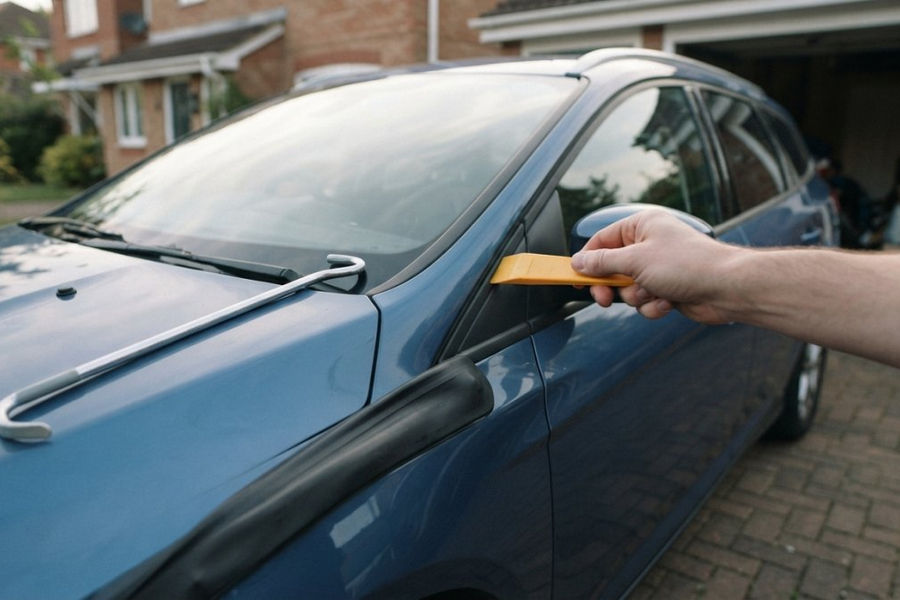
The wedge and long reach tool is the method professionals use most often, and it requires the most care if you're doing it yourself.
What you need:
An inflatable wedge or plastic shim
A long reach tool
A torch to see what you're doing
Patience
Model-specific limitations:
Deadlocked vehicles (most cars built after 2010): the interior handle and unlock button are electronically disabled when double-locked, so reaching them achieves nothing.
Cars with an interior motion sensor: the alarm may trigger the moment the wedge breaks the seal.
Cars with laminated side glass: the glass won't flex like tempered glass, so the wedge has almost no gap to work with.
Cars with anti-tamper tilt sensors: jacking or rocking the vehicle can set off the alarm.
Watch Out If your car has keyless entry, do not assume the wedge method is safe. Many keyless systems log a "door ajar without fob present" event, which can trigger the alarm and, on some models, temporarily disable the starter.
Shoelace Method for Pull-Up Locks
The shoelace method only works on older cars with pull-up locks (vertical pins sticking up from the door panel), where it's the least damaging DIY option.
How it works:
Take a long shoelace and tie a loop in the middle.
Slide the lace into the gap at the top of the door, aiming for the lock pin.
Once the loop is around the pin, pull both ends firmly upward.
The lock should pop up.
Model-specific limitations:
Cars with shielded lock pins: some manufacturers fitted a plastic collar around the pin to defeat the shoelace method.
Cars with central locking only: there is no pin to grab, so the method cannot work.
Cars with an alarm linked to the door switch: lifting the pin may trigger the alarm even if the door opens.
Coat Hanger for Older Vehicles
A coat hanger is the classic DIY tool, but also the most likely to cause damage. It works best on older vehicles with simple latches and no anti-theft shielding.
The risks:
The hanger can scratch the glass or paint.
It can snag and damage the window regulator.
Modern cars have plastic shields inside the door to block exactly this method.
If you trigger the anti-theft system, the car may lock down completely.
Model-specific limitations:
Cars with a door module: the interior handle sends an electronic signal rather than a mechanical pull, so hooking it does nothing.
Cars with an immobiliser linked to the alarm: triggering the alarm can leave the car unable to start until the code is cleared.
Cars with acoustic glass: the seal is tighter and the hanger is more likely to tear the rubber.
Key Takeaway The coat hanger method is the most likely to cause damage and the least likely to work on any car built in the last 15 years. If you drive anything modern, skip it.
Smartphone Apps and Remote Unlock
Some manufacturers offer smartphone apps that unlock your car remotely. If your car has this feature and you've set it up, it's the easiest and safest option.
What you need:
A car with connected services (most cars built after 2018 have this option)
An active subscription (some manufacturers charge a monthly fee)
Your login details
A phone signal
Model-specific limitations:
Cars with subscription lapsed: the app may show the vehicle but refuse the unlock command until renewed.
Cars in poor signal areas: the command may time out; try again near a window or in the open.
Cars with valet mode active: the app may be locked out until valet mode is disabled from inside the car.
Pro Tip If you have a connected app, set it up and test the remote unlock function now, while you still have your keys. It takes two minutes and can save you a call-out later.
When to Stop and Call for Emergency Car Lockout Assistance
Emergency car lockout assistance is the right call when DIY fails, when your car has modern security features, or when you're in an unsafe location.
Word of Advice TV
Stop and call for help if:
Your car has a deadlock system (most cars built after 2010)
You've already tried one method and it didn't work
You're parked on a busy road, in bad weather, or in an unsafe area
You can see damage starting to happen (bent frame, scratched glass)
Your keys are visible inside but you can't reach them
A child or pet is locked inside (call 999 immediately)
Finding a Mobile Locksmith Service Near Me
Searching for a mobile locksmith service near me usually means you need help now. The right provider comes to you and opens your car without damage.
What to look for:
Accreditation: RAC accreditation or membership of a recognised trade body shows the locksmith meets industry standards.
Insurance: A fully insured locksmith protects you if something goes wrong.
Guarantee: A 12-month guarantee on work means you're covered if the fix fails.
Local coverage: A truly mobile service should reach rural areas, not just city centres.
Reviews: Check Google, Facebook, and Yell for recent feedback.
Clear pricing: Ask for the call-out fee and the cost of the work before you agree.
Questions to ask when you call:
How long until you arrive?
What's the total cost, including call-out?
Are you insured?
Do you guarantee the work?
Can you program a new key if mine is lost?
Pro Tip Save your local auto locksmith's number in your phone now, before you need it. When you're locked out in the rain, you won't want to be searching for a reputable provider.
What Does Lost Car Key Replacement Cost?
Lost car key replacement cost depends on your car's make, model, and key type. A basic metal key for an older car costs far less than a modern fob with a transponder chip and remote functions.
What affects the price:
Key type: A simple cut key is cheapest. A transponder key, remote fob, or smart key costs more.
Programming: Modern keys must be programmed to your car's immobiliser. This requires specialist equipment.
Dealership vs. auto locksmith: Dealerships often charge more because of higher overheads.
Emergency call-out: A late-night or weekend call-out may carry a premium.
How to avoid overpaying:
Get a quote before you agree to the work.
Ask whether the price includes programming and VAT.
Check whether the locksmith can cut and program on-site, or whether you'll need a dealership.
Insurance and Roadside Assistance Coverage for Lockouts
Insurance and roadside assistance coverage for lockouts varies widely: some policies include it as standard, others charge extra or exclude it. Before you pick up a wedge or coat hanger, spend five minutes checking what you already have, it could save you the repair bill and an argument with your insurer.
Check your policy for:
Roadside assistance: Many breakdown policies include lockout help as part of the service.
Home start: If you're locked out at home, you may need "home start" cover, not just roadside.
Key cover: Some insurers offer separate key insurance that pays for replacement if your keys are lost or stolen.
Excess: Even if you're covered, you may pay an excess.
What's usually not covered:
Damage caused by a failed DIY attempt
Lockouts where you left the keys inside on purpose (some policies exclude this)
Replacement keys if you didn't take out key cover
Pre-Attempt Coverage Checklist
Run through this before any DIY method. It takes a few minutes and shows what you stand to lose if something goes wrong.
Find your policy schedule. Look for the sections on roadside assistance, home start, and key cover.
Check the lockout wording. Some policies say "keys locked inside" is covered; others say "keys lost or stolen" only. These are not the same thing.
Check the excess. A £50 excess on a £120 call-out may still be worth claiming; a £100 excess on a £90 call-out is not.
Check whether DIY damage is excluded. Most policies treat damage from a failed break-in attempt as accidental damage, which can affect your no-claims discount.
Check your warranty. Prying the door frame or damaging the window regulator may void the warranty on those components.
Check your breakdown provider's app. Many let you request lockout assistance directly through the app, which is faster than calling.
Watch Out If you damage your car trying to break in, your insurer may treat it as accidental damage and raise your premium. Always check your policy before you start prying.
How a Failed DIY Attempt Affects a Claim
This is the part most guides skip. If you damage the weather stripping, bend the door frame, or burn out a window regulator yourself, the insurer's first question is how it happened. A claim for "I tried to break into my own car" is assessed differently from "a locksmith opened it and the seal was already worn."
A common pattern is:
The insurer pays for the repair but records it as an at-fault or accidental damage claim.
Your no-claims discount is reduced at renewal.
The excess is deducted from the payout.
If the damage is judged to be from negligence, some policies reduce the payout or refuse it.
What to do instead:
Call your breakdown provider first. If they cover lockouts, they'll send help and the cost is usually included in your cover.
If they don't cover lockouts, ask them to recommend an approved locksmith, which can keep the work within your policy terms.
Keep the receipt and a note of the time you called as evidence if you later claim.
Key Takeaway A five-minute check of your policy is cheaper than a bent door frame. If your cover includes lockout assistance, use it, that's what you're paying for.
Conclusion
Being locked out is stressful, but it doesn't have to ruin your day. Know when to try DIY and when to call for help: if your car is modern, you're in an unsafe spot, or a method isn't working after a few minutes, stop. A professional call-out can often cost less than repairing damage.
Frequently Asked Questions
How do you unlock your car if your keys are locked inside?
If your keys are locked inside, first check if your car has a smartphone app or connected service that allows remote unlocking. If not, and you have no spare key, calling a professional mobile locksmith is the safest option. DIY methods like using a wedge and long reach tool can work but risk damaging the door frame or weather stripping. Emergency car lockout assistance is available from mobile locksmiths who can open your car without damage.
Is it safe to try and open a locked car door myself?
It can be safe if you use the right technique and tools, but there is always a damage risk. Methods like the shoelace trick for pull-up locks or a coat hanger for older cars are low-risk if done carefully. However, modern vehicles with anti-theft systems and sensitive locking mechanisms can be damaged easily. If you are unsure, it is better to call a professional locksmith to avoid costly repairs.
How long does an emergency auto locksmith take to arrive?
Response times vary by location and provider. A reliable mobile locksmith service near you will typically give an estimated arrival time when you call. In rural areas, it may take longer than in towns. When you contact a locksmith, ask for a realistic time frame and confirm they cover your area. Salisbury Auto Keys, for example, serves Wiltshire, Hampshire, Dorset, and parts of Somerset, and aims to arrive as quickly as possible.
Does my insurance cover vehicle lockout services?
Some comprehensive car insurance policies or roadside assistance add-ons include lockout cover. Check your policy documents or call your insurer to confirm. If you have breakdown cover, it may also include vehicle entry. Without cover, you will need to pay for a locksmith yourself. It is worth checking before you call, as some providers can arrange assistance directly and bill your insurer.
ask us now


Comments