
Auto Locksmith Insurance Coverage Explained (2026)
Table of Contents
What Auto Locksmith Insurance Actually CoversPublic liability and third-party property damageProfessional indemnity and the high-tech key programming gap
Public liability and third-party property damage
Professional indemnity and the high-tech key programming gap
Public Liability Insurance for Locksmiths: What It ProtectsBodily injury, accidental damage and the policy excess
Bodily injury, accidental damage and the policy excess
Car Key Replacement Insurance Coverage: What Your Own Policy Pays ForKey replacement add-ons versus standard motor cover
Key replacement add-ons versus standard motor cover
How to Verify Locksmith Accreditation and Insurance Before You BookWhat 'fully insured' should mean in practice
What 'fully insured' should mean in practice
Auto-Specific Risk: Vehicle Entry, Immobilisers and ECU Programming
If Something Goes Wrong: How a Claim Is SettledWhat insurers actually ask forHow fault is established for programming failures
What insurers actually ask for
How fault is established for programming failures
Frequently Asked Questions
Last Updated: September 13, 2026
What Auto Locksmith Insurance Actually Covers
Auto locksmith insurance is a specialised form of tradesman insurance that protects mobile locksmiths against the specific risks of working on vehicles, including third-party property damage, professional negligence, and damage to customer vehicles during key programming. At Salisbury Auto Keys, we carry full cover precisely because the work we do, from roadside entry to ECU programming, creates risks that a standard tradesman policy won't touch.
Most guides treat auto locksmithing as a sub-category of general property locksmithing. It isn't. When you cut a key for a house, the worst outcome is a scratched door. When you programme a transponder key for a modern vehicle, a mistake can immobilise the car entirely.
That distinction matters for anyone trying to understand what cover actually exists in this trade. The three pillars are public liability, professional indemnity, and tools and equipment cover, and each addresses a different failure mode.
Cover Type | What It Protects Against | Typical Claim Scenario |
Public liability | Third-party property damage, bodily injury | Damaging a customer's vehicle during entry |
Professional indemnity | Financial loss from negligent work | Key programming that fails weeks later |
Tools and equipment | Theft or damage to your own kit | Diagnostic equipment stolen from a van |
Employers' liability | Injury to employees | A trainee injured on a callout |
Business interruption | Lost income after a disruption | Van off the road for two weeks |
Public liability and third-party property damage
Public liability insurance for locksmiths covers claims made by third parties for injury or damage caused during your work. For an auto locksmith, that usually means vehicle damage: a scratched door panel during a lockout, a broken window clip, or damage to trim while removing a door card.
The policy excess is the amount you pay toward each claim before the insurer covers the rest. A common mistake is choosing the cheapest premium without checking the excess. A low monthly payment means little if the excess wipes out the value of a small claim.
Indemnity limits typically run from £1 million upward for tradesman policies, though the right figure depends on the vehicles you work on (abi.org.uk). If you regularly handle high-value cars, a £1 million limit may not reflect your actual exposure.
Professional indemnity and the high-tech key programming gap
Professional indemnity covers financial loss arising from professional negligence: work that was done incorrectly, or advice that turned out to be wrong. This is where the auto locksmith trade has changed dramatically in recent years.
Modern vehicles use immobiliser systems, transponder chips, and ECU programming that require specialist diagnostic equipment. If a key you programmed fails six months later and the customer has to pay for recovery and a dealership visit, that's a professional indemnity claim, not a public liability one. Many general tradesman policies exclude this entirely.
Watch Out The most common gap in auto locksmith cover is programming work. A policy that covers lockouts but excludes ECU programming leaves you exposed on exactly the jobs that carry the highest claim value. Check the exclusions list, not just the headline cover.
Public Liability Insurance for Locksmiths: What It Protects
Public liability insurance for locksmiths protects against claims from people who aren't your employees, covering bodily injury, accidental damage to their property, and the legal costs of defending a claim. It is the baseline cover for any mobile trade, and it applies whether you're working at a roadside, a driveway, or a workplace car park.
For auto locksmiths, the practical scenarios are straightforward. You're leaning into a vehicle to reach a door mechanism. You're using tools close to paintwork and glass. You're working on a customer's property, sometimes in poor light or bad weather. Each of those creates a route to an accidental damage claim.
Bodily injury, accidental damage and the policy excess
Bodily injury claims are rarer in this trade than property claims, but they carry the highest potential cost. A customer tripping over your equipment, or a passer-by injured while you work at the roadside, both fall under public liability.
Accidental damage is the everyday risk. A scratched wing mirror, a cracked trim clip, a scuffed alloy. These are small claims individually, but they add up, and a policy with a high excess means you're paying for most of them yourself.
Contractual liability is worth understanding too. If a commercial client asks you to sign a contract that makes you responsible for more than your policy covers, you're carrying that risk personally. Insurers often exclude liabilities you've agreed to contractually rather than those imposed by law.
Car Key Replacement Insurance Coverage: What Your Own Policy Pays For
Car key replacement insurance coverage is a separate question from the locksmith's own insurance. It concerns what your motor policy pays when you lose your keys, and the answer depends entirely on whether you have a key replacement add-on.
Standard comprehensive motor cover does not automatically include key replacement. Many drivers assume it does, then discover the gap when they're standing next to a locked car.
Key replacement add-ons versus standard motor cover
A key replacement add-on typically covers the cost of a replacement key, and sometimes lock reprogramming, if your keys are lost or stolen. The terms vary widely between insurers, and the exclusions matter more than the headline benefit.
Policy Type | Covers Key Replacement? | Typical Conditions |
Standard comprehensive | Usually no | Check your schedule |
Comprehensive with key add-on | Yes | Often requires police report if stolen |
Third-party fire and theft | Rarely | Limited or no key cover |
Breakdown membership | Sometimes | Recovery only, not replacement |
If you're locked out and your policy doesn't cover replacement, you're paying for the service directly. That's why it's worth checking your schedule before you need it, not after.
Pro Tip Photograph your key and fob now, and note the key code if you have it. Insurers and locksmiths can often work faster with that information, and some policies require proof of ownership before paying a key replacement claim.
How to Verify Locksmith Accreditation and Insurance Before You Book
Verifying locksmith accreditation and insurance takes about five minutes and protects you from the biggest risk in this trade: uninsured or unqualified operators. Ask three questions before you book anyone.
First, ask for the insurance certificate. Not a verbal assurance, the actual document. A legitimate operator will send it without hesitation.
Second, check the accreditation. RAC accreditation, for example, requires an operator to meet standards for work quality and insurance. You can verify a claim directly with the accrediting body rather than taking a logo on a website at face value.
Third, ask what happens if something goes wrong. A professional will explain their insurance position and their guarantee clearly. Vagueness here is a warning sign.
What 'fully insured' should mean in practice
"Fully insured" is a phrase that means very little on its own. It should mean public liability cover, professional indemnity cover, and employers' liability cover if the business employs anyone. For an auto locksmith, it should also mean the policy explicitly covers key programming and vehicle entry.
If an operator can't tell you their indemnity limit or name their insurer, treat that as your answer.
Auto-Specific Risk: Vehicle Entry, Immobilisers and ECU Programming
Vehicle entry, immobiliser work, and ECU programming carry risks that general tradesman insurance was never designed to cover. This is the gap most competitors ignore, and it's the one that matters most to anyone working on modern vehicles.
Vehicle entry on a modern car means working around deadlocks, anti-theft systems, and sensitive electronics. Damage caused during entry can be expensive, and some manufacturers treat certain interventions as voiding parts of the vehicle warranty.
Immobiliser and ECU work raises the stakes further. A failed programming job can leave a vehicle undriveable, requiring recovery and a main dealer visit. The financial loss to the customer can run into four figures, and that's a professional indemnity claim.
Cyber liability is an emerging consideration too. Modern diagnostic equipment connects to vehicle systems and sometimes to manufacturer platforms. A data breach or unauthorised access through that equipment is a real, if uncommon, exposure that forward-looking policies now address.
If Something Goes Wrong: How a Claim Is Settled
A claim is settled through a defined process: you report the incident to your insurer, they assess liability and quantum, and they either pay, dispute, or decline based on the policy terms. Understanding that process before you need it makes the whole thing less painful, and it is the part most guides skip entirely.
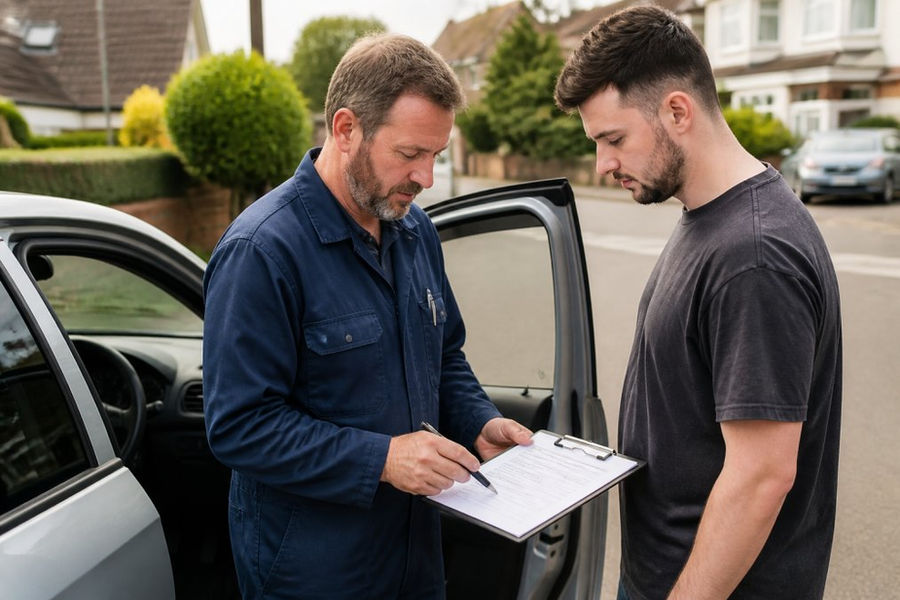
The walkthrough looks like this:
Report immediately. Most policies require prompt notification, often within a set number of days. Delays give insurers grounds to question the claim, and late notification is one of the most common reasons a valid claim is reduced or declined.
Document everything. Photographs of the vehicle before and after, the customer's account in writing, your own notes, diagnostic logs and any screenshots from programming software. For programming claims, the diagnostic log is often the single most important piece of evidence.
Insurer assesses liability. They determine whether the policy covers the incident and whether you were at fault. For a programming failure, they will look at whether the work was within the scope of your cover, whether you followed the manufacturer's procedure, and whether the loss was caused by your error or by a pre-existing fault.
Quantum is agreed. The value of the claim is negotiated or assessed, factoring in the excess. For vehicle damage, this usually means an independent engineer's report. For programming failures, it means quotes for recovery, dealer diagnosis and repair.
Settlement or dispute. If the claim is declined, you have a right to challenge the decision through the insurer's complaints process.
What insurers actually ask for
In practice, the evidence pack for an auto locksmith claim tends to include:
The customer's written account and contact details
Your job sheet or callout record, including the vehicle registration and mileage
Photographs of the vehicle and any damage
Diagnostic logs or screenshots from the programming session
Any correspondence with the customer about the fault
Proof of your qualifications or accreditation for the work carried out
Missing any of these can slow a claim down or give the insurer a reason to question it. A simple habit of photographing the vehicle on arrival and saving diagnostic logs after every programming job removes most of that risk.
How fault is established for programming failures
This is the area where claims are most often disputed. The insurer will typically ask whether the failure was caused by your work, by a pre-existing fault in the vehicle, or by something outside your control such as a power interruption or a manufacturer software issue. If the cause is genuinely unclear, the claim may be declined or settled on a without-prejudice basis.
That is why professional indemnity cover for programming work is different from public liability. Public liability responds to physical damage you caused. Professional indemnity responds to financial loss caused by your professional work, and it is the cover that actually protects you when a programming job goes wrong.
Most claims in this trade are small property damage matters that settle quickly. The ones that drag are the professional negligence claims, because fault and causation are harder to establish.
The Financial Ombudsman Service handles disputes if you and your insurer cannot reach agreement, and it is free to use.
For customers, the practical takeaway is simpler: ask any locksmith you book for their insurance details, and check that the cover includes the specific work they are about to do. A locksmith carrying proper cover is a locksmith who can make things right if something goes wrong. Salisbury Auto Keys carries full insurance, holds RAC accreditation, and backs every job with a 12-month guarantee, so if a key we have programmed stops working, you are covered without a call-out charge.
Frequently Asked Questions
What is car insurance key protection and how does it work?
Key protection is usually an optional add-on to a comprehensive motor policy. It pays out towards replacing keys and, in some cases, recoding the vehicle if keys are lost or stolen. Payout limits and the policy excess vary by insurer, and many standard policies exclude lost keys entirely. Check your schedule before assuming you are covered, and keep receipts for any replacement work so a claim can be evidenced.
What is the difference between public liability and professional indemnity for locksmiths?
Public liability covers injury to people and damage to third-party property while you work, such as scratching a customer's paintwork during vehicle entry. Professional indemnity covers financial loss caused by your advice or workmanship, for example a badly programmed key that leaves a customer unable to start the car. A specialist auto locksmith insurance policy normally carries both, because the two risks are quite different.
How do I verify locksmith accreditation and insurance before booking?
Ask for the insurance certificate and check the policy is current, names the business, and states the indemnity limit. For accreditation, confirm the scheme directly rather than relying on a logo on a van or website. A legitimate operator will send documents without hesitation and explain exactly what is and is not covered before any work begins.
Does my standard car insurance cover locksmith services?
Usually not. Standard comprehensive policies cover the vehicle itself, not the cost of a locksmith attending a lockout. Some insurers offer key replacement as a paid add-on, and breakdown providers may include lockout assistance within a membership. If you are locked out, expect to pay the locksmith directly and check afterwards whether any add-on you hold reimburses the cost.
ask us now


Comments